
Scalp-safe approach
Establish a live scalp-relative datum, maintain a defined force ceiling, tolerate human movement, and prevent unsafe motion independently of hair capture.
RAE / Robotic Aesthetic Engineer
RAE is an autonomous haircutting system being developed to safely perceive, capture, stabilize, and cut human hair on a moving person.
Designed from more than three decades behind the chair. Now being translated into sensing, controls, mechanics, and machine intelligence.
It bends, stretches, tangles, compresses, changes with moisture, and moves differently across density, texture, curl pattern, length, and prior damage.
A robotic haircutting system must do more than recognize a hairstyle. It must continuously understand where the person is, determine what the machine is touching, control hair under tension, and prevent cutting motion whenever reality disagrees with the model.
The haircut is the visible result. Reliable physical interaction is the actual invention.
Each layer earns the next layer’s authority.
Translate haircutting knowledge into structured geometry: shape, length, elevation, direction, boundaries, and sequence.
Use RGB, depth, and spatial sensing to estimate the head, hair, tools, environment, and human movement.
Confirm the current physical relationship between machine and person through compliant contact and force sensing.
Handle selected hair as a controlled bundle instead of attempting to cut loose hair in open space.
Require independent agreement across live contact, force, proximity, containment, tool state, position, and human veto channels before granting temporary, revocable cutting authority.
Operate only inside a mechanically bounded and verified path after permission has been granted.
Monitor force, motion, proximity, sensor agreement, interruption states, and execution results.
The map is a belief. Live touch is truth. Steel never moves on the map alone.
Vision guides the system. It does not receive sole authority to move a cutting tool near a person.
AetherFlow is RAE’s hair-handling architecture. Its purpose is to gather selected hair, separate it from uncontrolled material, establish direction and tension, present it at a defined cutting plane, contain the cutter’s path, and evacuate severed fibers.
The current work is not about maximizing suction. It is about producing a repeatable mechanical state from material that does not naturally want to be repeatable.
RAE does not ask a robot arm to recreate a human hand. It redesigns the task so the machine can perform it safely.
RAE is in the bench-validation stage. There is no functioning autonomous pod today. The finished pod is the product vision. The present work is the machinery and evidence required to earn it.
Evidence register / public view
Deliberate boundary
Mechanism geometry, dimensions, tuning, sensor thresholds, control rules, and raw validation material are shared only with vetted technical collaborators.
Join the build ↗What exists
Current proof sequence
Establish a live scalp-relative datum, maintain a defined force ceiling, tolerate human movement, and prevent unsafe motion independently of hair capture.
Demonstrate repeatable capture, isolation, alignment, and stabilization of a defined hair bundle.
Demonstrate that stabilized hair can be severed accurately inside a mechanically bounded operating path.
Combine perception, contact, handling, cutting, evacuation, interruption, and logging into a measurable bench cycle.
We are not building the pod first. We are building the reasons the pod deserves to exist.
Maintain an accurate relationship to a deformable, partially obscured surface while the person moves.
Determine whether the end effector is interacting with free hair, compressed hair, scalp, ear, clothing, or another object.
Maintain useful contact without rigid positioning or exceeding safe forces.
Convert inconsistent loose fibers into a stable, measurable bundle without damage or over-tension.
Prevent the cutting mechanism from operating outside its contained and verified path.
Define behavior when vision, depth, force, position, and contact signals tell different stories.
Create repeatable behavior across texture, density, moisture, length, and prior damage.
Turn “it appears to work” into instrumented, repeatable, falsifiable evidence.
RAE begins locked. Physical containment, live sensing, tool readiness, and human veto must independently agree before one temporary cutting action can exist. A person can revoke that authority at any moment.
Nothing moves until the system earns authority.
The current gap is not another concept designer, branding agency, or person who believes robots are neat. RAE needs technical people who want to help prove the hard parts.
Primary need
A long-term engineering partner with meaningful experience in some combination of:
The right person does not need to know hair. They need to be curious about unfamiliar physical problems, comfortable building crude evidence before polished products, and willing to challenge assumptions without killing the ambition.
Someone who likes an ugly working rig more than a gorgeous render.
Also interested in hearing from
Since 1989
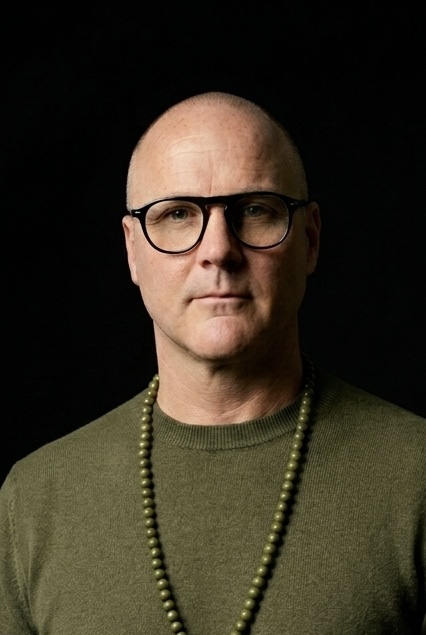
RAE was founded by Thad Grace, a hairdresser, artist, builder, and Brazilian jiu-jitsu black belt based in Oregon.
Thad started hair school in 1989 at 17 years old. Decades behind the chair taught him that haircutting is not primarily about the blade. It is the constant work of reading material, controlling tension, responding to movement, protecting the person, and making hundreds of small decisions under uncertainty.
RAE began with a question: could that embodied knowledge be translated into a machine without stripping away the care that makes the work human?
“The goal is not to make a robot imitate a hairdresser. The goal is to understand the work deeply enough to redesign it for a machine.”
Build the evidence
RAE is not currently selling pods. It is building the technical foundation required to make them possible.
We are looking for engineers, researchers, collaborators, and one serious technical co-builder who sees the size of the problem and wants to work on it anyway.